07 Nights / 08 Days Fully Guided Tours Private Car
Delhi - Agra - Ranthambore - Udaipur - Jodhpur - Jaisalmer - Jaipur - Delhi
Desert sand blowing across the tracks near Jaisalmer is something few luxury train passengers ever see, because most rail circuits in Rajasthan stop well short of the Thar. The Deccan Odyssey Heritage Odyssey Tour goes all the way. Over seven nights this round trip from Delhi visits Agra, Ranthambore, Udaipur, Jodhpur, Jaisalmer and Jaipur, and it ends back in the capital the following Saturday. The train leaves Delhi in the early evening, so you can arrive in India, rest for a night or two and board without an early start.
The appeal of this circuit is its depth in one region. Rather than racing across the country, it lingers in the former kingdoms of Rajasthan, each with its own character: Udaipur with its lakes and white palaces, Jodhpur beneath its great fort, Jaisalmer built of golden sandstone in the middle of the desert, and Jaipur with its pink old city and hilltop strongholds. The Taj Mahal and a tiger safari in Ranthambore give the opening days a different flavor, and the return to Delhi makes it easy to connect with international flights. Departures for 2026-27 are 10 October, 31 October, 21 November, 5 December, 2 January, 27 February and 17 April.
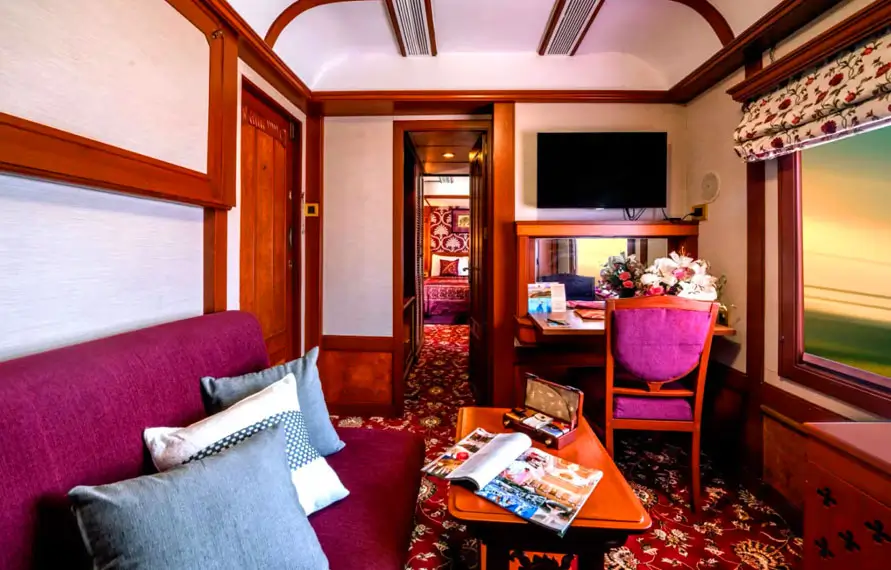
The Deccan Odyssey, operated by Maharashtra Tourism with Indian Railways, offers Deluxe Cabins and Presidential Suites with private bathrooms, a pair of dining cars, a lounge bar, a compact fitness room and an Ayurvedic treatment car. Our firm, Top Indian Holidays, has been running private tours out of Jaipur for more than two decades with Ministry of Tourism, Government of India recognition, and we work independently of the train to secure your cabin, Delhi hotel nights, private transfers and any extra time in Rajasthan before or after the journey. Our home city is on this route, and our team knows it well.
The Heritage Odyssey begins in the early evening, which leaves your last day in Delhi free. Use it for a gentle morning at the hotel, a light lunch and perhaps a short visit to Lodhi Garden, where locals walk among fifteenth-century tombs under tall trees. If you arrived in India only the day before, a rest in the afternoon is the best preparation, since the next morning starts early and there is a lot to see in Agra. Our team calls you during the day to confirm the pickup time.
Our driver collects you in the late afternoon and takes you to the Delhi station named in your joining instructions, where the train departs at around 18:00. The crew greet you on the platform with a welcome drink and a garland of marigolds, and registration takes only a few minutes. Your cabin attendant leads you to your room, which has a double or twin beds, wardrobe space, a desk and a private shower room. Unpack as much as you like, because you keep this cabin for the whole week.
As the train leaves Delhi behind, the city lights give way to the dark fields of Uttar Pradesh. Dinner is served in the restaurant car, where Indian dishes from the regions on your route share the menu with continental options. The dress code in the evenings is smart casual. After dinner you might take a drink in the bar lounge, browse the small library or simply turn in early. Let your attendant know when you would like to be woken with a pot of tea, since the Agra day begins at about 08:30.
Tundla, a rail junction on the edge of Agra, is where the train halts overnight, and once breakfast is over a coach covers the forty or so minutes into town. Today the guide frames everything around the idea of the Mughal garden, the walled paradise divided into four parts by water channels that the dynasty brought from Central Asia. You see it first at the Taj Mahal, arriving at about 09:30, where the long reflecting pool and four quarters of lawn lead your eye to the tomb at the far end, set unusually on the riverbank rather than in the center.
Spend time walking slowly around the platform of the Taj Mahal. From the river side you see the Yamuna and, across it, the site of the Moonlight Garden, from which the emperors once viewed the tomb by night. Inside the main chamber, light filters through carved marble screens around the cenotaphs of Shah Jahan and Mumtaz Mahal. The monument is closed every Friday, which this Sunday visit avoids. Shoe covers are provided, and a small torch helps to see the inlaid stones glow. Large bags are not allowed inside, so carry only essentials.
After lunch at a city hotel you visit Agra Fort, the massive red sandstone citadel begun by the emperor Akbar in the sixteenth century. Its marble pavilions overlook the river, and its gardens repeat the same geometric layout in miniature. Late in the afternoon you call at an inlay workshop to see artisans at work. Then you return to the train for dinner at around 19:00, and the Deccan Odyssey departs for Sawai Madhopur at about 20:00, arriving close to the national park before dawn.
This is an early day, and dressing well makes it far more enjoyable. You set off at about 06:30 in an open safari vehicle for a game drive in Ranthambore National Park. In the cooler months the first hour can be bitterly cold, with temperatures of 6 to 9 degrees Celsius between November and January, so wear a warm jacket, a hat and gloves you can still use a camera with. By the end of the drive you will be peeling off layers as the sun climbs over the hills.
Your naturalist uses everything the forest offers to find a tiger: alarm calls from spotted deer and gray monkeys, fresh paw prints in the dust and the behavior of birds. Tigers in Ranthambore are often seen walking along tracks or resting near the lakes below the fort, but every drive is different and no sighting can be promised. Even without a tiger, the morning is full of life, with crocodiles basking on the banks, large brown deer grazing in the shallows and kingfishers diving for fish. Ruined pavilions and banyan trees add to the atmosphere.
You return to the train at around 11:30 for a late breakfast or early lunch, and the train leaves Sawai Madhopur almost at once, heading south-west toward Udaipur. The afternoon is free, and after the early start many guests sleep for an hour. Others book a massage at the spa car or sit in the lounge editing photographs as the landscape becomes greener and hillier. Dinner is served on board as the train climbs into the Aravalli range, the ancient line of hills that runs across Rajasthan.
Udaipur was founded in the sixteenth century, when the rulers of Mewar moved their capital here from the old fortress of Chittorgarh. What makes Udaipur remarkable is its water engineering: a linked series of man-made lakes, linked by channels and dams, that turned a dry valley into a city of reflections. Your guide explains this as you begin the day at about 10:00 at the City Palace, a long complex of palaces built by many rulers over the centuries, rising directly from the shore of Lake Pichola.
Inside, you walk through courtyards, private chambers and terraces with mosaics of peacocks in colored glass. The views from the upper windows show exactly how the lakes shape the city, with temples and old mansions stepping down to the water. A launch then carries you out for an hour or so on Lake Pichola, gliding past the Lake Palace and Jag Mandir, its island companion. On a still day the reflections are perfect. Sunglasses and a hat are useful, since the glare off the water can be strong.
Lunch is served at a city hotel at about 13:30, and at 14:30 your guide leads a walking tour through the old city market. The lanes climb and twist between small temples, jewelers, painters and textile sellers, and the pace of life is slower than in Jaipur or Delhi. Shopkeepers here are known for their miniature paintings and for colorful printed quilts. Guests are back on board by around 18:00, the wheels start rolling for Jodhpur at 20:00, with dinner on board as the train heads north-west.
You reach Jodhpur in the morning, and after breakfast you head up to Mehrangarh Fort at about 10:30. Founded by Rao Jodha of the Rathore clan in the fifteenth century, the fort stands on a sheer rock face above the city, and its walls in places rise more than thirty meters. On this visit the guide concentrates on the fort as a fortress: the seven gates of the ascent, the cannonball marks still visible in the walls and the handprints of royal widows near the final gate.
Higher up, the mood changes completely as you enter the palace apartments. The Phool Mahal, a hall of gilded ceilings and painted walls, and the Sheesh Mahal, a room of mirrors, show the wealth that the desert trade routes brought to the Rathores. The museum's collections of canopied elephant seats, palanquins, arms and miniature paintings are well labeled. From the ramparts, the blue houses of the old city spread out below like spilled paint, and on clear days the view stretches far across the plain toward the desert.
Lunch is back on the train, and the afternoon brings you to Jaswant Thada, the late nineteenth-century cenotaph raised in memory of Jaswant Singh II, a ruler of Marwar. Its marble panels are cut so finely that sunlight passes through them with a soft amber glow, and the small lake and gardens beside it are peaceful. Later in the afternoon the program often includes a ride to the Clock Tower market in the old city. The train leaves at about 20:00 for Jaisalmer, traveling deep into the Thar Desert.
By morning the view outside the window has turned into desert scrub, sand and grazing camels. You step down at about 08:30 in Jaisalmer, a town founded in the twelfth century by the Bhati Rajput ruler Rawal Jaisal as a stronghold on the caravan routes between India and Central Asia. Jaisalmer Fort rises above the town on a hill called Trikuta, its walls of yellow sandstone glowing like gold in the morning sun. It is one of the few forts in the world where people still live inside the walls.
Your guide leads you through the fort's main square, past the royal palace, and into a cluster of Jain temples with exquisitely carved pillars and ceilings. Inside the walls, families run small guesthouses, cafes and shops in houses that have been occupied for centuries. Below the fort you visit Nathmal Ji Ki Haveli, a merchant's mansion whose facade was carved by two brothers working on opposite halves, each with a slightly different design. Look for the carved elephants and the delicate stone screens of the upper balconies.
Lunch waits on board from roughly 13:30, after which you can rest during the warmest part of the day. At about 15:00 you drive out to the sand dunes west of the city for sundowners as the light softens and the sand turns from pale yellow to deep orange. Camel rides are usually available for those who would like one. Desert evenings cool quickly, so bring a shawl or light jacket. You return to the train at about 18:30, and it departs at about 20:30 for the long overnight run east to Jaipur.
You arrive in Jaipur at about 08:30 and leave for Amber Fort half an hour later. Local guides like to say that this city is best understood from above, and the morning soon proves them right. From the ramparts of Amber Fort you see how the old capital was protected by a ring of hills, walls and watchtowers, with the larger Jaigarh Fort keeping guard on the summit behind. The guide explains how the Kachwaha rulers combined Rajput and Mughal styles in the palace courtyards.
Inside Amber you visit the Hall of Public Audience, the Ganesh Gate with its painted arches and the private palace of mirrors, where a single flame lights up thousands of tiny glass pieces. Morning brings softer light and fewer visitors. Lunch is served at a city hotel at about 13:00, and the restaurants of Jaipur's heritage hotels are known for royal Rajasthani recipes, such as slow-cooked mutton with smoked spices, which are worth trying if you eat meat. Vegetarians are equally well served, since Rajasthan has one of the richest vegetarian kitchens in India.
At about 14:30 you visit the City Palace, where the former royal family still occupies part of the complex, and see the textile and arms galleries and the ornate Peacock Gate in an inner courtyard. On the way you drive past Hawa Mahal, the delicate pink screen of a palace built so royal women could watch life on the street below. You return to the train at about 18:30 for the farewell dinner, and the Deccan Odyssey departs at about 20:00 for the overnight run back to Delhi.
An early breakfast comes to the table while the train rolls through Delhi's suburbs, and the journey ends on arrival in the capital in the morning. Take your time saying goodbye to the crew who have looked after you all week. Our driver meets you on the platform with your name on a sign, takes care of your bags and drives you on to a hotel or straight to your flight. Expect a run of 30 to 60 minutes between the main stations and the international terminal, depending on traffic and the time of day.
If you have a late flight, we can reserve a day room so you can rest and pack in comfort. With a few hours to spare, Humayun's Tomb, the Qutub Minar or a walk through the lanes of Old Delhi make good final visits, and a guide can be arranged at short notice. For shopping, the government-run crafts emporium and the boutiques of Khan Market and Santushti offer quality goods from across India without the bargaining you met in the markets of Rajasthan. Everything can be shipped home.
Many guests decide to extend their trip after this journey. Popular options include a stay in a palace hotel in Udaipur, a few days in Varanasi on the Ganges or a week in Kerala on the backwaters and beaches. Top Indian Holidays arranges each extension with flights, private cars, English-speaking guides and hotels we have personally inspected. Someone from our office can be reached at any hour until your plane takes off, and we always enjoy hearing how the trip went once you are home. Many guests come back for a southern route.
Fill out this form with all the required information. Within 12 hours, we will provide you with a tailor-made itinerary at the best price.
Read the reviews of our esteemed client's, go through the experiences they had with Top Indian Holidays.

Whether you're planning your first India trip or returning to explore deeper — get honest, expert advice from someone who knows every corner of this country. No pressure, no cost.



 info@topindianholidays.net
 +91-8955000999