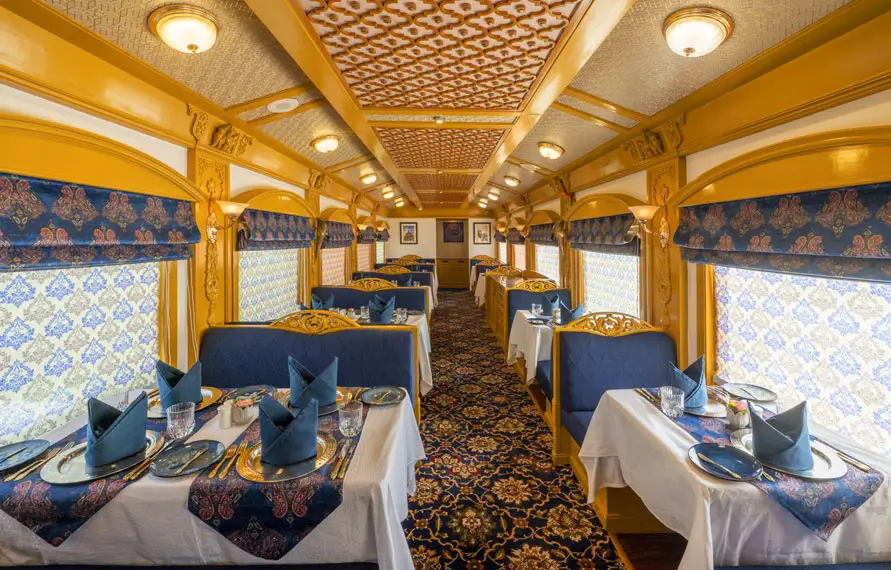
07 Nights / 08 Days Fully Guided Tours Private Car
Delhi - Ranthambore - Jaipur - Agra - Gwalior - Orchha - Khajuraho - Varanasi - Delhi
Gwalior Fort, the riverside palaces of Orchha and the sandstone temples of Khajuraho sit on very few luxury rail routes in India, and the Deccan Odyssey Cultural Odyssey Tour links all three in a single week. The journey leaves Delhi in the evening, sleeps its way through Rajasthan and central India, reaches the holy city of Varanasi on the last full day and returns to the capital on the eighth morning. Because the train covers most of the distance at night, every day begins at a new platform with a guide, a coach and a clear program already arranged.
This is the route for travelers who are more curious about history and architecture than about desert dunes. After a tiger safari in Ranthambore and two classic days in Jaipur and Agra, the train turns south-east into Madhya Pradesh, where crowds thin out and the monuments become older and stranger: a hilltop fortress with turquoise tile work, a forgotten Bundela capital on the Betwa River, and temple walls carved with thousands of figures a thousand years ago. The week ends on the Ganges at Varanasi, a fitting close to a journey built around faith, art and royal power.
The Deccan Odyssey is run by Maharashtra Tourism together with Indian Railways, and it carries a spa, a gym, lounges and a bar alongside its dining cars and cabins with private bathrooms. The 2026-27 season has four departures, on 28 November, 26 December, 6 March and 10 April; the December date spans the New Year and carries a festive surcharge. Top Indian Holidays, a privately owned Jaipur company holding Ministry of Tourism approval and unconnected to the train's operators, reserves your cabin, meets you in Delhi and can add hotel nights, private guides or a beach or mountain extension on either side of the train.
The Deccan Odyssey Cultural Odyssey begins in the evening, which gives you a free day in Delhi to rest after a long flight or to see one or two sights at a gentle pace. Late afternoon is a good time for a walk around Humayun's Tomb, whose red sandstone and marble domes glow warmly as the sun drops. Our driver then collects you from your hotel with enough time to reach the station before check-in, allowing for Delhi's heavy evening traffic, which can turn a twenty-minute drive into an hour.
At the platform the train staff greet you with a welcome drink, check your passport and booking, and take your bags to the cabin. Each cabin has its own bathroom, a wardrobe, a writing table and a wide window, and the attendant explains the call button, the safe and the morning tea service. Take a few minutes to unpack properly, as you will live out of this room for seven nights. Hang the clothes you need for formal dinners and keep a light jacket, sunglasses and walking shoes near the door for daily excursions.
Dinner is served in the restaurant car as the train pulls out of Delhi and heads south-west toward Sawai Madhopur. The menu mixes Indian regional cooking with continental dishes, and the kitchen is used to handling vegetarian, vegan and gluten-free requests if you mention them on the first night. After dinner, the lounge is a relaxed place to meet fellow guests, many of whom come from Europe, North America and Australia. Ask the guest relations team for the next morning's safari timing before you turn in, since it starts early.
The train reaches Sawai Madhopur in the early morning, and you transfer by coach to Ranthambore Tiger Reserve for a jungle safari. In late November and December the morning slot runs from about 07:00 to 10:30, while in March and April it starts closer to 06:30. Expect real cold on early winter drives, when the thermometer can sit between 6 and 9 degrees Celsius as the jeep leaves the gate, so pack a fleece, gloves and a scarf. Your naturalist follows alarm calls from spotted deer and gray monkeys, which often reveal a hidden tiger or leopard.
Even without a big cat, the drive is rich. The reserve covers dry forest, open grassland and a string of lakes below the walls of Ranthambore Fort, a tenth-century stronghold that rises on a ridge inside the park. Large brown deer stand knee-deep in the water, crocodiles bask on the banks, and birds such as painted storks, crested serpent eagles and bright green bee-eaters are common. Keep your camera ready but quiet: guides ask guests to stay seated, avoid bright clothing and speak softly when animals are close.
After lunch on board, the afternoon brings a village safari, a slower look at rural Rajasthan. You ride through farmland where mustard and wheat grow in winter, stop at homes with mud-plastered walls and painted doorways, and see how families tend cattle, carry water and cook over open fires. It is a short visit, and guests are encouraged to ask before photographing people. Back on the train, dinner is served as you travel north toward Jaipur, a short overnight hop of only a few hours.
Breakfast on board, then a coach takes you into the walled old city of Jaipur, which Sawai Jai Singh II mapped out on a grid during the early eighteenth century before later rulers painted it its famous terracotta pink in the following century. Your first stop is the City Palace, where courtyards open one into another through gateways decorated with peacocks, roses and lotus flowers. The palace museum holds royal costumes, weapons and miniature paintings, and descendants of the old royal house continue to live in one wing of the palace.
A short drive brings you to Hawa Mahal, the five-story screen of small windows built so that royal women could watch processions in the street without being seen. The best photographs come from the cafes on the opposite side of the road, which have upper terraces facing the facade. Nearby stands Jantar Mantar, an outdoor observatory with giant masonry instruments that still tell the time to within a few seconds when the sun is out. Your guide can explain how each instrument works, including the huge sundial whose shadow moves visibly as you watch.
The afternoon is set aside for the old city markets, where each street once belonged to a particular trade. Gem cutters in Jaipur handle a large share of the world's colored stones, and the city's other crafts include hand-stamped cotton, blue pottery, silver jewelry and hand-knotted rugs. Government-run and set-tag emporiums are easier for first visitors, while the open markets reward some patient negotiation. If shopping is not your interest, a quiet afternoon on the train or a spa treatment is a welcome alternative. The train leaves for Agra after dinner.
Agra is reached overnight, and after breakfast on board you head for the Taj Mahal, the white marble tomb built by Shah Jahan for his wife Mumtaz Mahal. Arriving in the morning keeps you ahead of the hottest part of the day and gives soft light on the dome. Security is strict: large bags, food, tripods and drones are not allowed, so carry only a small bag with your camera, phone and water. The monument closes every Friday, which the train schedule takes into account.
You enter with your guide beneath the great red sandstone gate, and the view of the tomb framed by the arch is one of the great moments in travel. Walk slowly along the water channels, then up onto the marble platform, and look closely at the flowers made of inlaid semi-precious stones such as carnelian, jade and lapis lazuli. Shoe covers are provided at the platform. The calligraphy around the main arch grows larger as it rises, so that it appears the same size from the ground.
Later you visit Agra Fort, a massive red sandstone citadel beside the Yamuna River that served as the main Mughal residence before the court moved to Delhi. Inside, the white marble pavilions built under Shah Jahan contrast sharply with the earlier sandstone halls of Akbar. From the Musamman Burj, an octagonal tower, you can see the Taj Mahal across the bend in the river, the same view the emperor is said to have had during his final years under house arrest. The train departs for Gwalior in the evening.
The morning begins at Gwalior Fort, set on a long sandstone plateau about one hundred meters above the city. The first Mughal emperor, Babur, called it the pearl among the fortresses of India, and its highlight is the Man Mandir palace, built by the Tomar ruler Man Singh in the late fifteenth century. Its outer walls are covered with glazed tiles in turquoise, yellow and green showing ducks, elephants, tigers and banana trees. Below, cool underground chambers kept the royal household comfortable in summer heat.
Within the fort walls you also see the Saas Bahu temples, a pair of eleventh-century shrines with heavily carved ceilings, and Teli ka Mandir, a tall temple with an unusual barrel-vaulted roof. On the approach road, huge Jain figures are carved straight into the cliff face, some of them several stories high. Wear comfortable shoes with grip, because the stone paths are worn smooth and some sections slope steeply. After the tour you return to the train for lunch as it continues south toward Orchha.
In the afternoon you reach Orchha, the sixteenth-century capital of the Bundela kings, which stands on an island in the Betwa River. You walk through Raja Mahal and the many-terraced Jahangir Mahal, then visit Chaturbhuj Temple, whose tall spires were designed to be seen across the plain. The day closes with a short look at village life and a view of the royal cenotaphs lined up along the riverbank, where vultures nest on the domes. Orchha is quiet and unhurried, and late light makes it especially beautiful.
Breakfast is served on board as the train crosses the farmland of northern Madhya Pradesh, a landscape of small fields, thorny scrub and rocky hills. The Khajuraho temples were built by the Chandela dynasty between roughly the tenth and twelfth centuries, and around two dozen of the original temples survive. They were largely forgotten by the outside world for centuries until a British survey officer recorded them in the nineteenth century, which helps explain why the carving survived in such fine condition, far from the armies that damaged temples elsewhere.
Your guided visit focuses on the Western Group, set in landscaped lawns that are pleasant to walk in the cool hours of the day. The tallest temple, Kandariya Mahadev, is covered in more than eight hundred carved figures, from gods and celestial dancers to musicians, soldiers, elephants and couples in tender embrace. The famous sensual sculptures form only a small part of the decoration. Your guide explains how the rising spires represent a mountain home of the gods and how worshipers moved around the inner chamber.
The afternoon allows time to see the Eastern Group, where the Jain temples, including Parshvanath, show some of the finest and most delicate carving at Khajuraho. Alternatively, you can rest on the train or book a massage at the spa car before the evening departure. Khajuraho town is small, with a few craft shops selling stone carvings, brass work and textiles from central India. Dinner is served on board as the train heads east overnight toward the Ganges and the final full day of the journey.
Varanasi is one of the oldest living cities in the world, and the morning program takes you into its crowded old quarter. Your guide leads you through narrow lanes barely wider than a person's arm span, past tiny shrines, sweet shops, tea stalls and wandering cows, toward the area around Kashi Vishwanath, the most important temple in the city. Phones and bags are not allowed inside the main temple compound, so the guide will explain the arrangements. Wear shoes you are happy to get dusty and dress modestly, with shoulders and knees covered.
A highlight of the day is a boat ride on the Ganges at Varanasi. From the water you see the long sweep of stone steps that run down to the river, with pilgrims bathing, priests sitting under bamboo umbrellas and laundry spread out to dry. At the cremation grounds, smoke rises day and night, and guides ask guests not to photograph the ceremonies there. The riverfront palaces above the steps were built by princely families from across India who wanted a residence in the holy city.
There is time later in the day to sit on the riverfront steps and simply watch daily life go by, or to visit one of the city's silk workshops, where Varanasi brocade is still woven on hand looms. Winter evenings by the river can be cool, so bring a warm layer. Ask the guest relations team whether your departure's program includes the evening fire ceremony, which in winter usually begins at about 18:00. The farewell dinner is served on board as the train runs west through the night toward Delhi.
Breakfast is served on board as the train crosses Uttar Pradesh on its final run to the capital. Use the morning to settle any bar or spa bills with the train staff, pack your bags and swap contact details with the people you have shared dinners and safaris with. Many guests like to thank their cabin attendant and the restaurant team in person, and tips can be handed over in an envelope at the end of the trip if you have not already contributed through the train's own arrangement.
The train arrives at Delhi Safdarjung station, and a driver from our team stands waiting beside the carriage with your name on a board, ready to take charge of the bags. Safdarjung is in the south of the city, about 30 to 45 minutes from the international airport in normal traffic. If your flight leaves late at night, a hotel room can be booked for the daytime, letting you shower, rest and repack before heading home, rather than spending long hours waiting at the airport. Our team keeps an eye on the arrival time and adjusts the pickup if the train runs late.
Top Indian Holidays, whose Jaipur office has organized private trips across India since the late nineties, can easily turn the end of the Deccan Odyssey Cultural Odyssey into the start of a longer holiday. Popular choices include a few days on a Goa beach, a slow week in Kerala among the backwaters, or an Udaipur lake palace stay for travelers who loved Rajasthan. Each extension comes with private cars, English-speaking guides and hotels chosen by our team, and we handle domestic flights and the timing around the train so that one booking and one point of contact cover your whole trip from the first night to the last.
Fill out this form with all the required information. Within 12 hours, we will provide you with a tailor-made itinerary at the best price.
Read the reviews of our esteemed client's, go through the experiences they had with Top Indian Holidays.

Whether you're planning your first India trip or returning to explore deeper — get honest, expert advice from someone who knows every corner of this country. No pressure, no cost.



 info@topindianholidays.net
 +91-8955000999