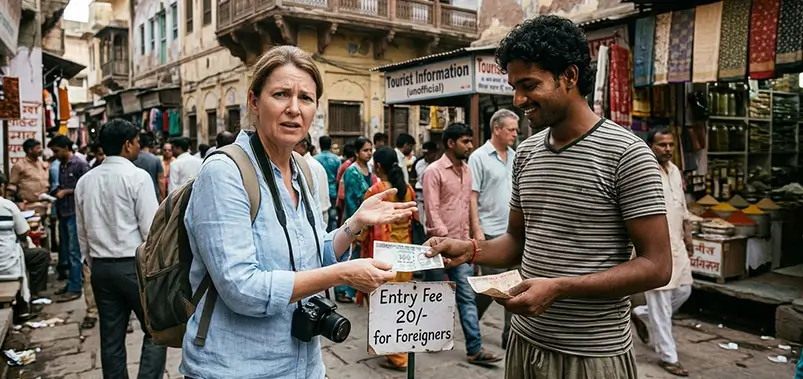
GST also applies to restaurant dining (5% at most restaurants, 18% at 5-star hotel restaurants) and on tour packages (5% on the full package value for packages with accommodation). For a luxury India tour package priced at $6,000, the 5% GST adds $300 to the total.
Don’t Let Hidden Costs Ruin Your India Trip
Travel smart with clear pricing, honest guidance and no surprise charges. Plan your journey with experts who ensure a smooth and worry-free experience.
Hidden Cost 3 — Tipping Culture in India: Who, How Much, and When
Tipping in India is not legally mandated — but it is culturally expected, and for service workers in the tourism industry, tips form a meaningful part of their income. Most international visitors either tip too little (not understanding the expectation) or tip inconsistently (not knowing who to tip).
Here is a complete, honest India tipping guide for foreign tourists in 2026:
Daily Tipping Reference — Private Tour
| Service |
Recommended Tip |
Notes |
| Private driver (full day) |
$6–10 per day |
Most important tip — your driver is with you constantly |
| Local tour guide (half day) |
$8–12 |
At each monument or city |
| Local tour guide (full day) |
$15–20 |
Full day specialist guide |
| Multilingual specialist guide |
$20–30 per day |
Senior expert — tip generously |
| Hotel porter |
$1–2 per bag |
At each check-in |
| Hotel housekeeping |
$2–3 per day |
Leave daily, not just at checkout |
| Hotel concierge (special service) |
$5–10 |
When they arrange something special |
| Restaurant service |
10% if not included |
Check bill — many add service charge |
| Spa / Ayurveda therapist |
$3–5 per treatment |
If service is excellent |
| Boat operator (Varanasi, Kerala) |
$3–5 |
For a memorable experience |
Total Tipping Budget for Common Trip Durations
| Trip Duration |
Estimated Total Tips Per Person |
| 7 Days (Golden Triangle, private tour) |
$120–180 |
| 10 Days (GT + extension, private tour) |
$170–250 |
| 14 Days (Rajasthan circuit, private tour) |
$230–340 |
Most travelers on a 10-day India tour budget $30–50 for tips. The actual amount is typically $170–250. This is the single most consistently underbudgeted cost on any India trip.
Luxury travel note: At the luxury travel tier — palace hotels, senior specialist guides, premium drivers — tipping expectations are higher and more impactful. A senior expert guide who speaks your language fluently, has spent 20 years developing specialist knowledge, and delivers an extraordinary day deserves $25–35 in tips. This is still dramatically less than what you would tip equivalent expertise in Europe or North America.
Hidden Cost 4 — Camera and Photography Fees at Monuments
This is one of the least discussed and most consistently surprising hidden costs in India for international visitors. Many of India's most famous monuments charge a separate fee for cameras — particularly professional cameras, DSLRs, and video equipment.
Photography Fee Guide — Major India Monuments (2026)
| Monument |
Mobile Phone |
Still Camera |
Video Camera |
| Taj Mahal |
Free |
Free |
₹500–1,000 ($6–12) |
| Amber Fort, Jaipur |
Free |
₹100 ($1.20) |
₹200 ($2.40) |
| Mehrangarh Fort, Jodhpur |
Free |
Included |
₹200 ($2.40) |
| Ellora Caves, Aurangabad |
Free |
₹25 ($0.30) |
₹25 ($0.30) |
| Ajanta Caves |
Free |
Free (exterior) |
₹25 ($0.30) |
| Most temples |
Ask locally |
Often prohibited |
Almost always prohibited |
Note: Policies change frequently and vary by site management. Always check at the entrance gate before assuming photography is free or included.
For luxury travelers carrying professional photography equipment — high-end cameras, tripods, drone equipment — additional fees and permit requirements apply at most heritage sites. Drone photography at ASI monuments requires advance government permission and is not a casual arrangement.
Hidden Cost 5 — Currency Exchange: Where You Lose Money Without Knowing
Every international traveler to India loses some money on currency exchange. The question is not whether it happens — it is how much, and whether you minimize it intelligently.
The Airport Exchange Trap
Airport currency exchange counters in India (and in your home country before departure) consistently offer exchange rates 4–7% worse than the interbank mid-market rate. On a $2,000 currency exchange, a 5% loss means $100 gone before your trip even begins.
ATM withdrawal fees at Indian ATMs add another ₹200–350 ($2.50–4) per transaction as a flat bank fee, on top of whatever international transaction fee your home bank charges (typically 1–3%).
Currency Exchange Cost Comparison (2026)
| Method |
Typical Cost/Loss |
Notes |
| Airport exchange counter |
4–7% above mid-rate |
Most expensive option |
| Hotel currency exchange |
3–5% above mid-rate |
Convenient but costly |
| Indian bank ATM |
₹200–350 flat + home bank fees |
Best rate but adds up |
| Wise / Revolut card |
0.5–1% |
Best option for most travelers |
| Pre-ordered currency (home bank) |
2–4% |
Better than airport |
Practical advice for luxury travelers: For large sums, wire transfers or pre-arranged banking through your travel agency are most efficient. For daily spending, a Wise or Revolut card delivering near-interbank rates eliminates most currency conversion losses. Never exchange large amounts at airport counters.
Hidden Cost 6 — Bottled Water: Small Daily Cost, Significant Total
Every foreign visitor to India should drink only sealed bottled water throughout their trip. Tap water — even in five-star hotels — is not considered safe for drinking by travelers who have not developed immunity to local bacteria. This is standard guidance, not alarmism.
The daily cost of bottled water is modest individually — but it accumulates meaningfully across a 10–14 day trip:
| Daily Water Consumption |
Cost Per Day |
10-Day Total |
| 2–3 bottles (standard) |
$2–4 |
$20–40 per person |
| 4–5 bottles (hot weather/active days) |
$4–7 |
$40–70 per person |
At luxury hotels, bottled water in your room is typically provided as part of the daily room service — replenished daily. However, water purchased at monument entrances, roadside shops, and restaurants is a direct daily expense.
Practical tip: Your private driver in India will typically have a supply of sealed water bottles in the vehicle — ask your agency to confirm this is included. Reputable operators like Top Indian Holidays include water in their vehicle service.
Hidden Cost 7 — Travel Insurance: Essential, Often Forgotten
Travel insurance for India is not optional — it is essential. India's medical costs for foreigners without insurance can be significant, and trip cancellation due to weather, political events, or personal illness is a real possibility on a complex multi-destination itinerary.
Recommended Coverage and Typical Costs
| Coverage Type |
Recommended Minimum |
Typical Premium (2-week trip) |
| Medical emergency |
$500,000+ |
Core of any policy |
| Medical evacuation |
$1,000,000+ |
Critical for remote areas |
| Trip cancellation |
Full trip value |
Protects your investment |
| Baggage loss |
$2,000+ |
Important for valuables |
| Total policy cost (2 weeks) |
— |
$80–200 per person |
For luxury travelers with significant pre-paid trip costs ($5,000–12,000 per person), "cancel for any reason" (CFAR) coverage is strongly recommended. This adds approximately 40–50% to the base premium but protects the full trip investment against any cancellation scenario.
Hidden Cost 8 — India e-Visa Fee
Many travelers research India travel costs without factoring in the India e-Visa fee — because they assume visas are either free or negligible. They are not free.
India e-Visa Fees by Nationality (2026)
| Nationality |
Tourist e-Visa (30 days) |
Tourist e-Visa (1 year) |
| USA |
$10–25 |
$40 |
| UK |
$10–25 |
$40 |
| Canada |
$10–25 |
$40 |
| Australia |
$10–25 |
$40 |
| Most EU nationalities |
$10–25 |
$40 |
The visa fee itself is modest. But the processing time (typically 3–5 business days, occasionally longer) catches many travelers off guard when they apply close to their departure date. Apply at least 2–3 weeks before travel.
Note: Some nationalities have different fee structures or additional requirements. Always verify current requirements at the official India e-Visa portal before applying.
Hidden Cost 9 — SIM Card and Mobile Data
Staying connected in India requires a local SIM card — international roaming rates from US or UK carriers make daily roaming prohibitively expensive for most travelers ($10–25/day for international roaming vs. $5–8 for a month of local data).
India Tourist SIM Options (2026)
| Provider |
Best Tourist Plan |
Cost |
Data |
Validity |
| Airtel |
International Tourist SIM |
₹500–699 (~$6–8) |
1.5–2 GB/day |
28–30 days |
| Jio |
International Tourist SIM |
₹399–599 (~$5–7) |
1–1.5 GB/day |
28 days |
Getting a SIM card in India requires your passport and arrival documentation. SIM cards can be purchased at the airport on arrival (Airtel and Jio both have booths at major international airports) or at mobile stores in the city. Your hotel concierge or travel agency can assist with SIM card purchase.
For luxury travelers: Your agency may arrange SIM card setup as part of arrival services — confirm this with Top Indian Holidays when booking.
Hidden Cost 10 — Commission-Driven Shopping Diversions
This is not a hidden cost in the traditional sense — but it is the hidden cost that generates the most frustration among international travelers, particularly those who did not book through a reputable agency.
Some freelance drivers and guides in India receive commissions from shops — textile stores, gem dealers, "government emporiums," and handicraft showrooms — for bringing tourists. When your driver "recommends" a particular shop or suggests a detour to an artisan workshop you did not request, there is often a commercial motivation behind the suggestion.
The result is that travelers end up in high-pressure sales environments buying items at inflated prices — sometimes spending $200–500 more than they intended on textiles, gems, or crafts of questionable quality and authenticity.
How to avoid this completely:
- Book your private driver and guide through a reputable India tour operator whose drivers do not receive shop commissions
- Politely but firmly decline any shopping suggestions not on your itinerary
- If you want to shop, ask your agency to recommend government-approved emporia or verified artisan studios before your trip
- Never buy gemstones or jewelry from driver-recommended shops without independent verification
Hidden Cost 11 — Alcohol Pricing and State Regulations
India's alcohol policies vary dramatically by state — and the cost of alcohol at tourist destinations consistently surprises travelers accustomed to Western pricing.
Alcohol Cost Reality in India (2026)
| Location / Situation |
Beer Cost |
Wine Cost |
Notes |
| Local liquor store (wine shop) |
₹150–250 ($2–3) |
₹500–800 ($6–10) |
Cheapest option |
| Mid-range restaurant |
₹300–500 ($4–6) |
₹800–1,500 ($10–18) |
Standard pricing |
| 5-star hotel bar |
₹600–900 ($7–11) |
₹1,500–3,500 ($18–42) |
Premium pricing |
| Rooftop heritage restaurant |
₹500–800 ($6–10) |
₹1,200–2,500 ($14–30) |
Tourist premium |
Dry states and dry days: Several Indian states have significant alcohol restrictions. Gujarat is a fully dry state (no alcohol sold or consumed legally). Bihar is dry. Many states observe dry days on national holidays and election days when alcohol sales are completely prohibited. Rajasthan, Delhi, Goa, Kerala, and Mumbai are alcohol-friendly — but surprise dry days can catch travelers off guard.
For luxury travelers: International wine and spirits at palace hotel bars are available but priced at significant premiums. Budget $30–60 per person per evening for drinks at five-star hotel bars.
Hidden Cost 12 — Laundry
On a 10–14 day India trip, laundry is a real operational cost that most travelers forget to budget for. India's climate (particularly October–March in North India) generates daily dust and perspiration that make fresh clothing essential.
| Laundry Option |
Cost Per Load |
Notes |
| Budget hotel / guesthouse |
₹200–400 ($2.50–5) per load |
Basic washing and folding |
| Mid-range hotel |
₹400–800 ($5–10) per garment or load |
Often per-item pricing |
| 5-star hotel laundry |
₹200–500 ($2.50–6) per garment |
Premium per-item charges |
| Local dhobi / outside laundry |
₹150–300 ($2–4) per load |
Cheapest option |
At luxury properties, per-garment laundry charges are common — $3–6 per shirt, $5–8 per trousers. A full laundry submission at a palace hotel can cost $30–60 per load if not managed carefully.
Practical tip: Ask your hotel to clarify whether laundry is per-garment or per-load before submitting. Many luxury properties offer a "laundry package" for extended stays that is significantly more economical than individual per-garment pricing.
Travel India Without Budget Surprise
Know your travel costs in advance with clear pricing and honest advice. Enjoy a smooth journey with no confusion, no extra charges and full support.
Chat On WhatsApp Contact Us
Hidden Cost 13 — Airport Transfers (When Not Pre-Booked)
Arriving at Delhi's Indira Gandhi International Airport, Mumbai's Chhatrapati Shivaji Maharaj International Airport, or Jaipur's Sanganer Airport without a pre-arranged transfer is one of the most reliably expensive mistakes international visitors make.
Unbooked airport taxis — especially at Delhi and Mumbai international terminals — charge tourist premium rates that can be 3–5x the appropriate fare. Drivers at arrival halls aggressively quote $40–80 for transfers that should cost $15–25.
| Transfer Method |
Delhi Airport to City |
Mumbai Airport to City |
Notes |
| Pre-booked private transfer |
$18–30 |
$22–35 |
Best option — fixed price |
| Delhi Metro (Airport Line) |
$0.80–1.50 |
Not applicable |
Good if luggage is manageable |
| Prepaid taxi counter |
$15–25 |
$18–28 |
Fixed rate, government-regulated |
| Random taxi (arrival hall) |
$40–80+ |
$50–100+ |
Highest risk of overcharging |
| Uber/Ola (booked on app) |
$8–15 |
$10–18 |
Good rate, needs working SIM |
For travelers on luxury India tours: Pre-arranged airport meet-and-greet and transfer service is included in full-service package bookings. Your driver will be waiting at the arrivals hall with a name board — eliminating the chaos of the unbooked arrival experience entirely.
Complete Hidden Cost Budget — What to Actually Add to Your India Trip
Here is a consolidated table of all hidden costs across a typical 10-day mid-range private India tour for two travelers:
| Hidden Cost Category |
Per Person (10 Days) |
Notes |
| Monument entry fees (foreigner) |
$90–130 |
10–12 major sites |
| GST on mid-range hotels (12%) |
$85–125 |
Based on $80/night avg room |
| Tipping (driver + guides + hotel) |
$170–240 |
Full tipping guide above |
| Camera fees |
$10–25 |
If carrying DSLR |
| Currency exchange losses |
$30–60 |
Avoidable with right card |
| Bottled water |
$25–45 |
Daily consumption |
| Travel insurance |
$90–150 |
Essential, not optional |
| India e-Visa |
$25 |
One-time cost |
| SIM card + data |
$6–8 |
One-time cost |
| Laundry |
$20–40 |
10-day trip |
| Airport transfers (if unbooked) |
$20–35 |
Arrival + departure |
| Total Hidden Costs Estimate |
$571–883 per person |
For 10-day mid-range tour |
For a 10-day luxury India tour, the hidden cost total is higher:
| Hidden Cost Category |
Per Person (Luxury, 10 Days) |
| Monument entry fees |
$100–150 |
| GST on luxury hotels (18%) |
$540–900 (based on $300–500/night avg) |
| Tipping (premium level) |
$250–380 |
| Travel insurance (CFAR) |
$200–350 |
| Currency exchange + misc |
$50–80 |
| Alcohol at 5-star venues |
$200–400 |
| Laundry at palace hotels |
$80–150 |
| Total Hidden Costs (Luxury) |
$1,420–2,410 per person |
This is why luxury India tour package quotes that do not include taxes, tips, and personal expenses appear lower than the actual all-in cost. Always ask your agency: "What is the total all-in cost including taxes, and what personal expenses should I additionally budget for?"
How a Good Travel Agency Eliminates Most Hidden Cost Surprises
The irony of India's hidden costs is that most of them are entirely preventable — not by spending less, but by planning with a reputable travel partner who surfaces all costs upfront.
At Top Indian Holidays, every package quotation includes:
- All taxes explicitly stated — GST and service charges shown separately, never buried
- Entry fee guidance — we inform every client about foreigner entry fees at each site on their itinerary before departure
- Tipping guidance — provided in our pre-trip briefing document
- Driver water inclusion — bottled water in vehicle is standard
- Airport transfers pre-booked — no arrival chaos
- Pre-trip cost summary — a complete breakdown of expected on-ground personal expenses so nothing surprises you
The result is that our clients arrive in India with an accurate budget and depart with no financial surprises. That is not luck — it is the difference between booking with an experienced India tour operator and booking components independently.



 info@topindianholidays.net
 +91-8955000999